Why First-Class Mail Is the Right Choice for Large-Scale, ROI-Driven Mail Campaigns
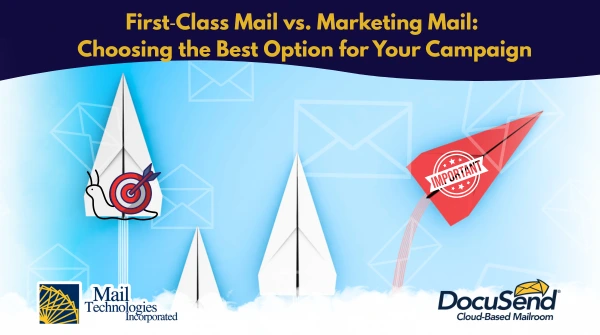
When businesses automate their outbound mail, one of the most important decisions they make is what mail class to use. While both USPS Marketing Mail (formerly Standard Mail) and First-Class Mail serve legitimate purposes, they carry very different levels of risk, visibility, and business impact.
For many organizations, especially those sending time-sensitive communications and targeted offers, the real question becomes: Is saving roughly $0.12 per piece worth the risk that your mail may never reach the recipient?
This article breaks down that decision clearly.
Bulk Reach vs. Guaranteed Delivery
Marketing Mail (formerly Standard Mail) is designed for high-volume, non-personalized advertising. It is commonly used for saturation campaigns, broad awareness efforts, and non-urgent promotions where delivery to every individual recipient is not essential.
First-Class Mail, by contrast, is intended for personalized, time-sensitive, or business-critical communications – including invoices, statements, notices, and targeted marketing pieces. When it comes to delivery speed, transparency, and open rates (i.e., what percentage gets opened), it is the clear winner here.
How Undeliverable Mail Is Handled: The Legal Difference Between First-Class and Marketing Mail
- The USPS has the legal right to dispose of undeliverable Marketing Mail (Domestic Mail Manual 507.1.5.3).
- Sending Marketing Mail, the mailer receives no return, no alert, no visibility, and no opportunity to correct the issue.
By contrast, First-Class Mail is legally protected.
- It must be delivered, forwarded, or returned.
- Mailers retain accountability and control.
In simple terms, Marketing Mail may disappear, while First-Class Mail creates a record. For companies, that difference directly affects ROI, compliance, and brand credibility.
The comparison table below highlights the advantages of First-Class Mail for your business.
| Category | First-Class Mail | Marketing Mail | Business Risk / Impact |
|---|---|---|---|
| Delivery Speed | 1–5 days (priority processing) | Often exceeds 5–10 days; varies widely during peak seasons | Timing risk – Delayed delivery can invalidate time-sensitive offers. |
| Delivery Reliability | High; consistent and prioritized | Variable; more prone to delays | Execution risk – Unpredictable outcomes complicate planning and forecasting. |
| Treatment of Undeliverables | Forwarded or returned at no extra charge | Most likely discarded | Undetected bad addresses cause list decay and repeated wasted spend. |
| Mail Security | Protected from inspection | Lower protection | Compliance and privacy risk – Sensitive content is more exposed. |
| Typical Response Rate | 3–5%+ | 0.5–2% | Performance risk – Low engagement increases cost per response and weakens ROI. |
| Discard Risk | Low (perceived as important or official) | High (often viewed as promotional) | Message loss risk – Materials may be discarded unread. |
| Long-Term ROI | Higher; stronger engagement and retention | Lower; requires higher volume to perform | Strategic risk – Ongoing scale is needed to offset weaker performance. |
| Typical Use | Bills, statements, notices, personal or business correspondence | Advertising, catalogs, coupons, fundraising | Misalignment risk – Marketing Mail weakens critical communications. |
| Best Use Cases | Time-sensitive mail, targeted marketing | Large promotional campaigns, general marketing | Opportunity risk – The wrong mail class limits impact despite strong messaging. |
Compare Delivery Speed of First-Class Mail vs. Marketing Mail
As you can see from the comparison table, First-Class Mail is typically delivered within 1–5 days nationwide and receives high priority in the USPS network, meaning it is processed before Marketing Mail. Important items benefit from consistently fast handling. Advances in USPS technology have reduced processing time by over eight hours since 1996. Marketing Mail, on the other hand, usually takes 5–10 days to reach recipients and is handled after First-Class and Package services. Its delivery speed is not guaranteed and can be slower during peak seasons.
How First-Class Mail Signals Value, Credibility, and Urgency
What is especially interesting is that, as an instinct and without realizing it, customers make a distinction between First-Class Mail and Marketing Mail when they sort through their mail. A First-Class indicia signals: "This may be important.” “This could affect me.” “This likely contains personal or valuable information.”
This perception alone drives open rates up. On the flip side, Marketing Mail tends to be treated as promotional clutter regardless of design and quality and is very often discarded unopened.
Mail that looks important is treated as important.
Table: What impact does First-Class Mail have on brand acceptance and open rates?
| Factor | Impact on Brand Acceptance | Impact on Open Rates |
|---|---|---|
| First-Class Mail Signals Higher Value | Higher postage reinforces perceived importance and credibility. | Recipients are more likely to open mail that appears important or official. |
| Faster Delivery (1–5 days vs. 5–10 days for Marketing Mail) | Timely arrival builds trust in the brand’s reliability. | Faster arrival leads to higher engagement and quicker opening times. |
| Protected & Confidential | Enhances brand professionalism and respect for customer privacy. | Privacy expectations increase the likelihood of opening official documents. |
| Association with High-Value Content (bills, statements ≈ 50% of volume) | Brands benefit from being grouped with essential financial communications. | Consumers prioritize opening mail they associate with important information. |
When to Pay for First-Class vs. Marketing Mail
Opt for First-Class Mail for:
- Financial documents like invoices, bills, late notices, statements
- Private letters, business documents, personalized customer communications
- Communications with a time constraint
- Industries driven by compliance, where communication carries financial, legal, or personal significance – including energy, utilities, healthcare, finance, insurance, and regulated services
- Scenarios that would warrant delivery proof
Choose Marketing Mail for:
- Large, nonurgent marketing campaigns
- Geographic saturation mailers
- Awareness-only advertising
- Generic mailings
First-Class Mail Wins: Higher ROI, Better Delivery, and Stronger Marketing Results
Being opened is often more important than being cheap. First-Class Mail often outperforms Marketing Mail when campaigns are highly targeted and personalized. If your messages are unique – aimed at specific individuals, time-sensitive, or based on past recipient behavior, interests, and purchases – and the campaign’s success depends on delivery certainty and engagement, First-Class Mail frequently delivers better overall ROI, even at a slightly higher per-piece cost.
The $0.12 Decision: Reducing Campaign Risk with First-Class Mail
Rather than focusing on postal rate tables, the practical decision comes down to this:
For roughly $0.12 more per piece, First-Class Mail is not only much faster but also reduces the risk that your message never reaches its destination. That incremental cost buys legal delivery protection, ensures mail accountability, and prevents silent failure of campaigns.
When weighed against the cost of creative design, printing, list acquisition, and lost conversion opportunities, that additional investment often represents the lowest-cost insurance in the campaign.
With First-Class Mail sent through services like DocuSend, you can track it all the way to the local carrier. DocuSend applies Intelligent Mail barcodes to every piece, enabling the USPS to scan events throughout processing and providing the ability to track milestones within the postal network.
This turns mail from a “black box” into a measurable channel.
How DocuSend Maximizes First-Class Mail Value
DocuSend removes the traditional friction associated with First-Class Mail by fully automating the process. Essentially, you get all the benefits of First-Class Mail with far less work and far greater consistency. Instead of dealing with long manual preparation and extended mailing timelines, everything is automated end-to-end. Documents and letters can be generated and uploaded to the cloud on the same day. Batches can be of any quantity, as there are no minimums or contracts, so you don’t need to wait to gather a certain number of documents to get automated mailing. DocuSend takes your documents from the cloud, automatically prints them, inserts them into envelopes, and passes them to the USPS. Addresses are validated automatically before printing, so the system minimizes undeliverable mail right from the start. There is no extra charge for this service.
Businesses get all the advantages of First-Class Mail without manual workflows, delays, or operational overhead. This cloud-based mailroom operates at a lower total cost than traditional in-house mail production. Plus, it is convenient for businesses that have fluctuating mail volumes. You can easily scale from just a few hundred pieces to tens of thousands without changing anything on your side.
Mailing first class through DocuSend puts your campaigns fully in view with your personal portal. You can track all your mailing activity and review expenses over the past six months.
A Smarter Way to Think About Mail Class
Marketing Mail can be effective for broad awareness at scale.
But when delivery, engagement, compliance, and visibility are critical, First-Class Mail transforms risk into certainty.
How has your mailing experience been? We’d love to hear your thoughts in the comments section below.